
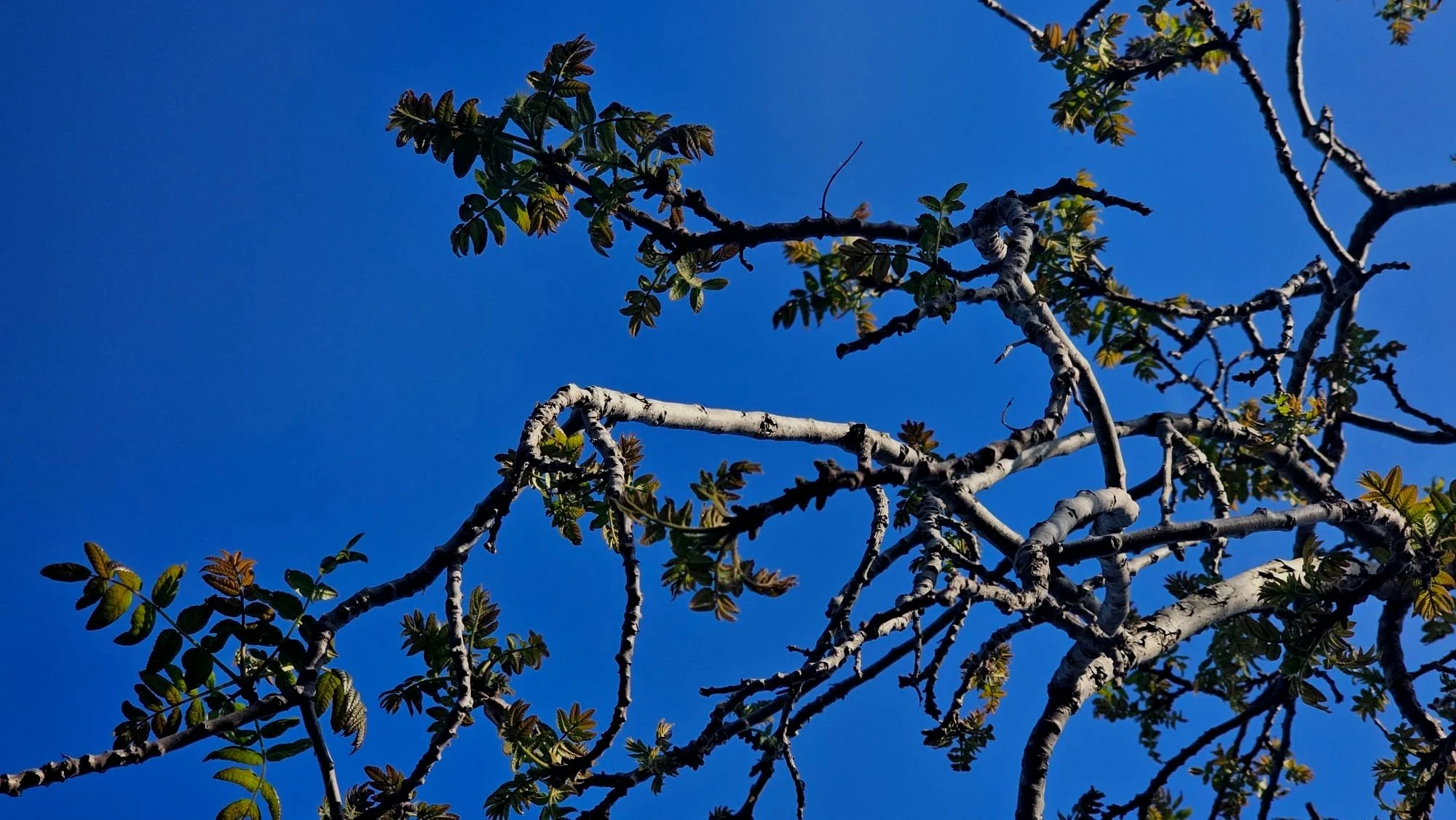
Southern California Black Walnut
Juglans californica | Juglandaceae
The Southern California Black Walnut is one of the most threatened species of Southern California.
The species is largely threatened by urbanization, as its population center co-occurs within the Los Angeles metropolitan area. A species distribution study estimates that Black Walnuts have lost 31% of climatically suitable habitat to human land use change and will lose an additional 33% of remaining suitable habitat by 2080 under moderate-high land use change scenarios (Riordan et al., 2016). The species is widely distributed throughout the slopes of the Santa Monica Mountains, the Hollywood Hills, and the San Rafael Foothills; further inland and South of its species range, walnuts are typically restricted to riparian corridors. The species is a foundation species for one of the most rare plant communities in California — the Walnut woodland.Reproduction
Black Walnuts are monoecious (both male and female flowers occur on the same plant) and primarily wind-pollinated. To prevent selfing, the species employs heterodichogamy — a mating system that leverages gender fluidity. Under heterodichogamy, an individual tree will only express one gender at a time before switching to the opposite gender. Most Black Walnut trees exhibit protandrous heterodichogamy (male to female) in Northeast and East LA, but a few protogynous trees (female to male) must be present to successfully fertilize these majority male-to-female trees. The evolutionary advantage of this system prevents inbreeding, as individual trees can only fertilize each other rather than themselves.
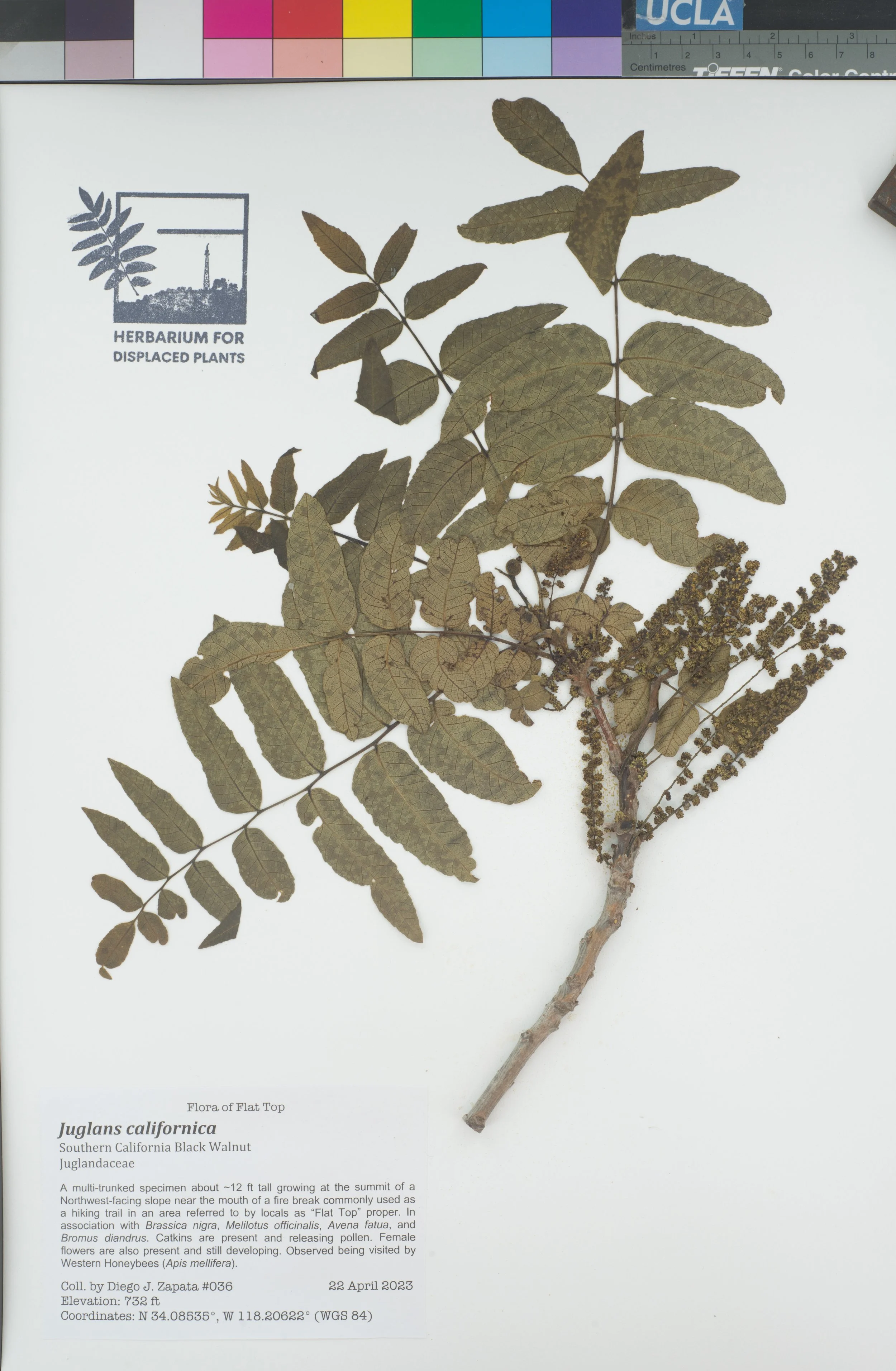
Male flowers (catkins) are specialized to release pollen when wind blows against them (Figure 1A).
Walnut trees flower March - May.
Figure 1. (A) Walnut catkins (or male) flowers. (B) Pistillate (or female) flowers
Description
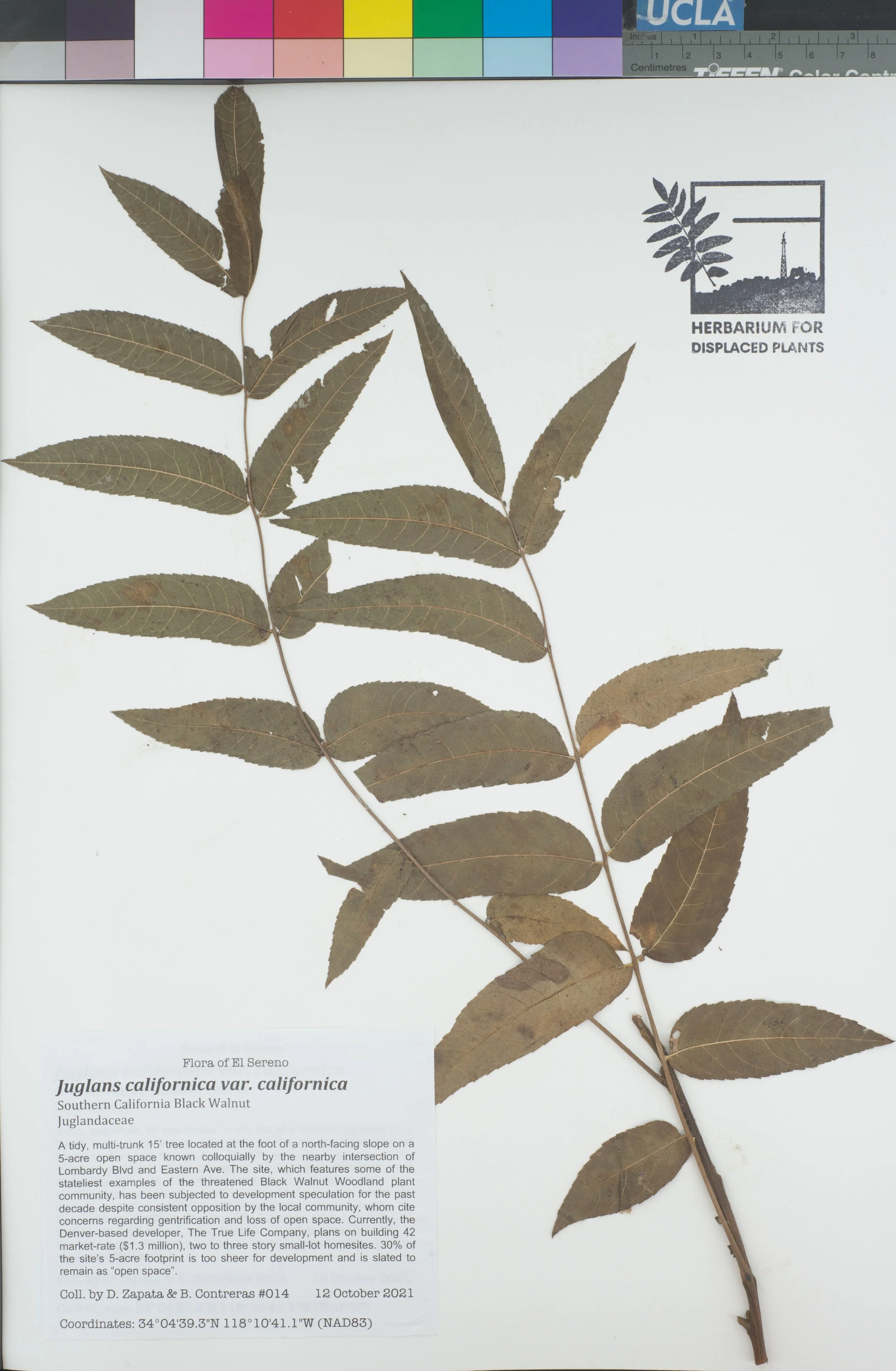
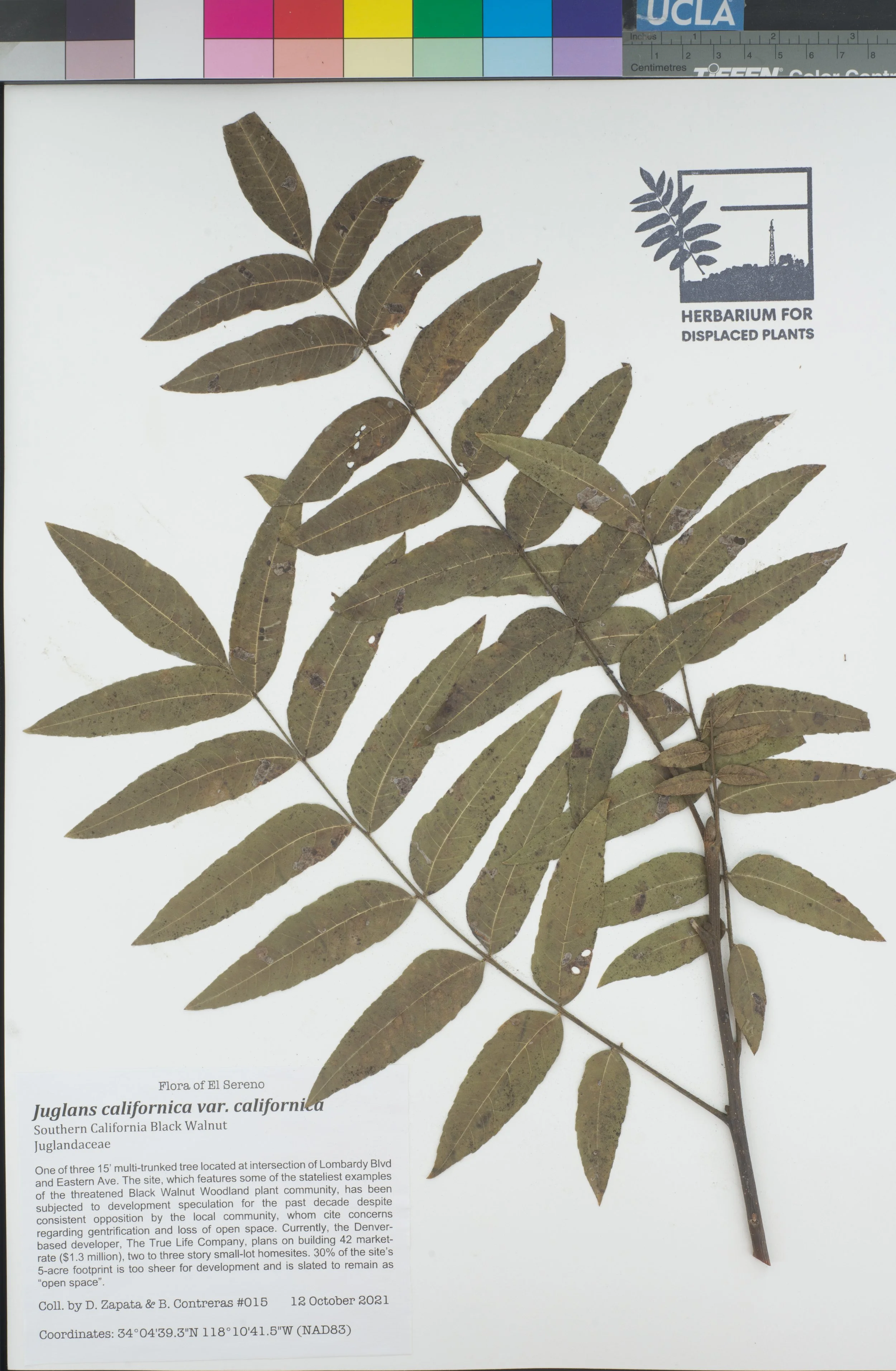
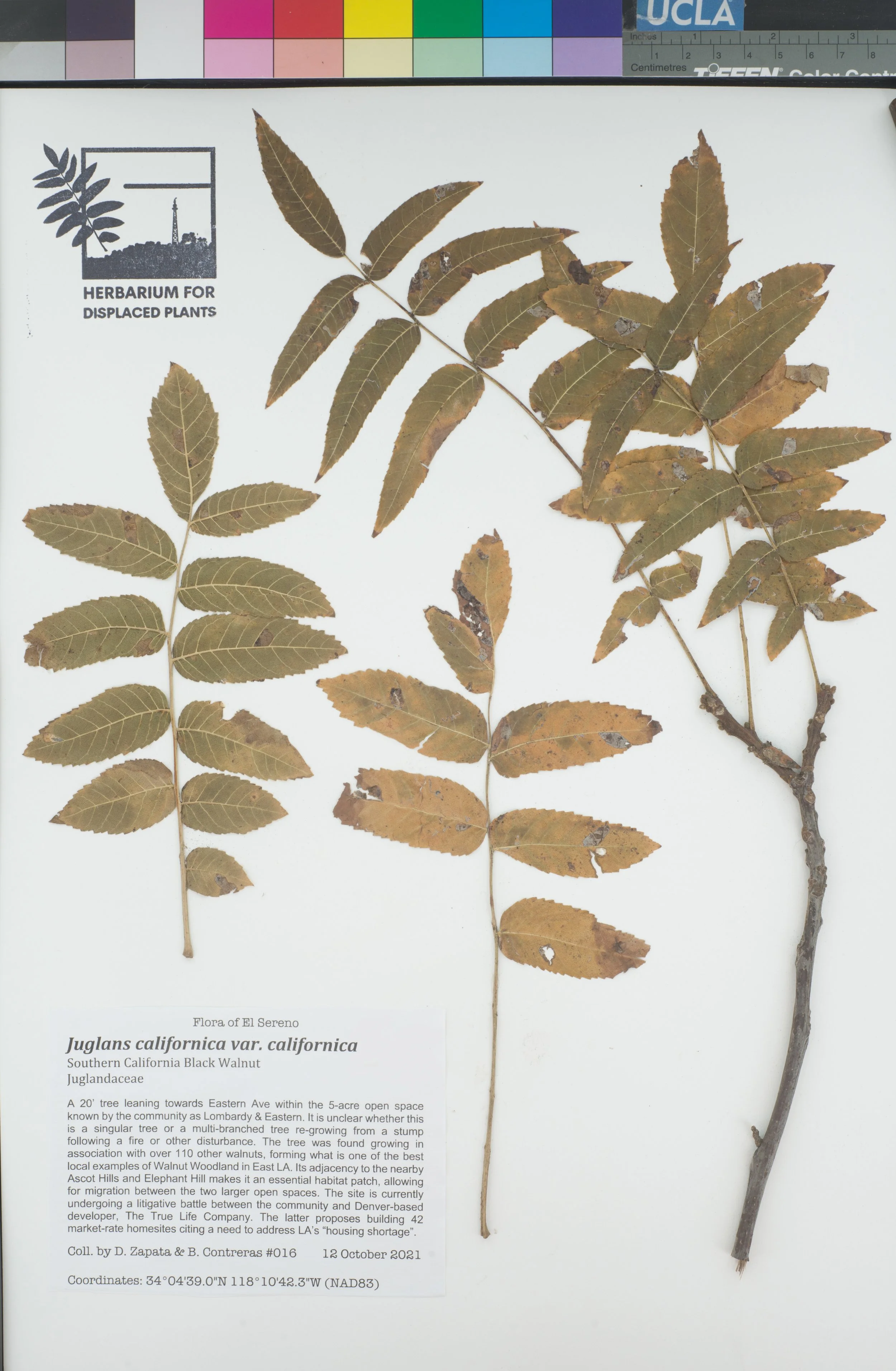
Habit. Black Walnuts can grow into a large multi-trunked tree or as a singular-trunked small tree or shrub. It tends to grow larger in areas that maintain more soil moisture and where it does not have to compete with other species for sunlight (Fig. 2A). Its height can vary from ~15 ft to 75 ft tall.
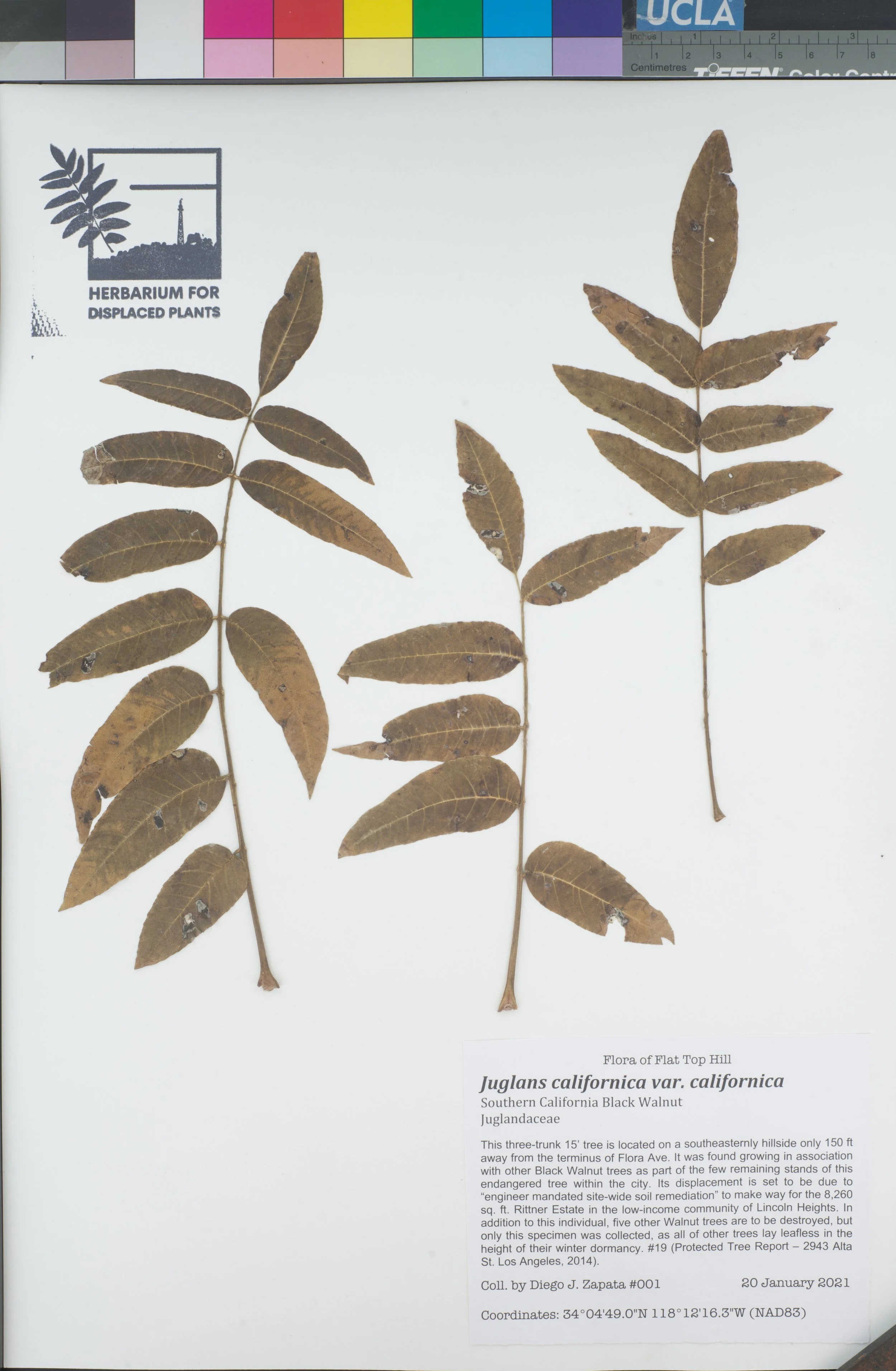
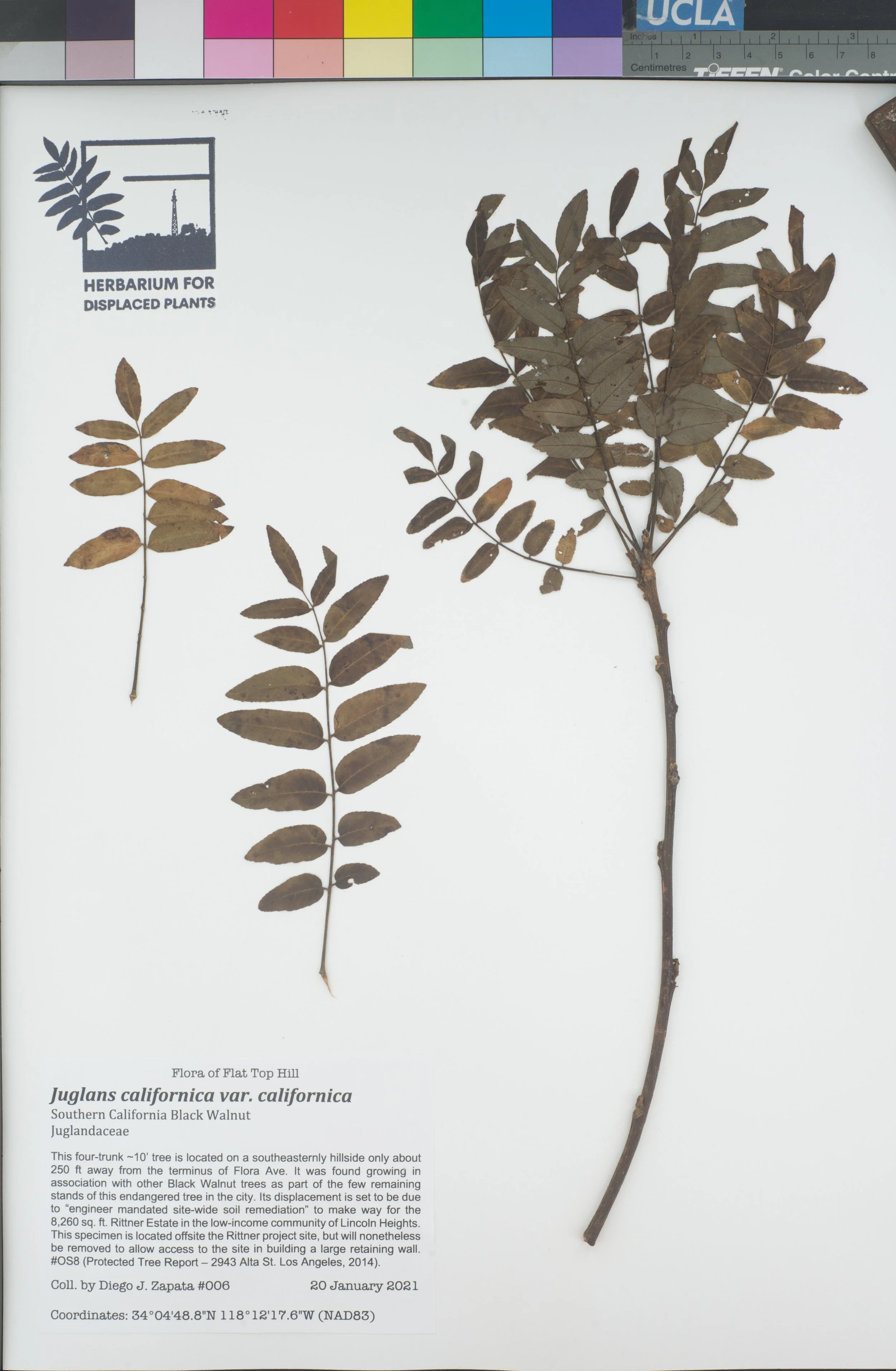
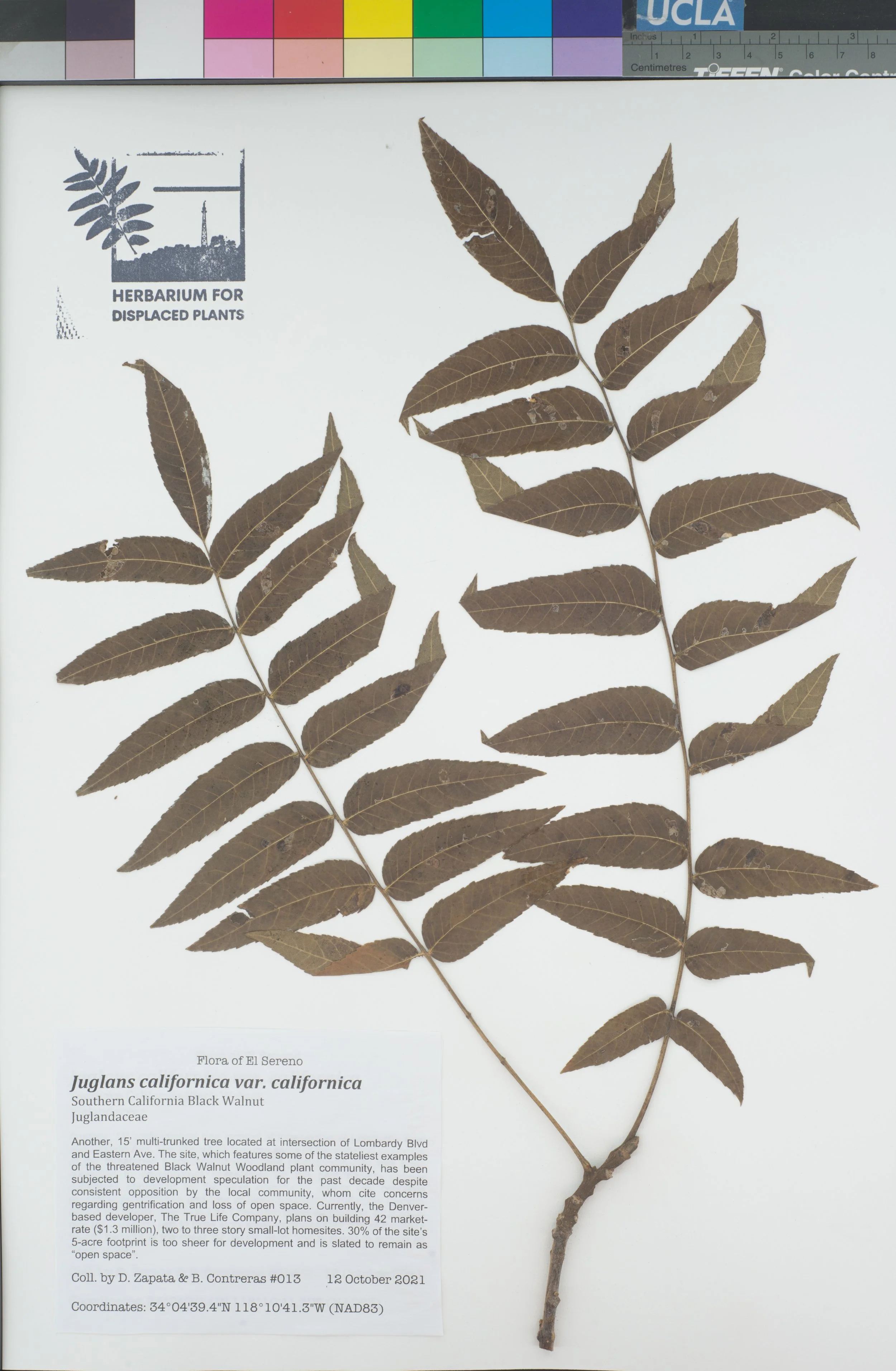
Leaves. Compound leaves, with 11-15 leaflets. Abaxial leaf surfaces are entirely glabrous (or smooth) (Fig. 2C). Typically fragrant. Juglans spp. leaves produce an organic compound, Juglone, that is allelopathic to some (usually unassociated) species and highly toxic to insect herbivores.
Fruit. 2--3.5 cm diam, nut shell thick, shallowly grooved. Ripe fruit are yellow and turn black with age. Husk of fruit stain hands, clothes, etc a deep brown.
Hybridization
In addition to urbanization and other land use changes, introgression with other Juglans spp. could threaten the viability of local populations of Southern California Black Walnut if hybridized individuals are less fit than parent species. All walnuts can hybridize with each other. Because Southern California is one of the most productive regions for commercial walnut production in the world, genetic material from walnut orchards growing English Walnuts (Juglans regia), Paradox hybrids (Juglans regia x Juglans hindsii), or Northern CA Black Walnuts (Juglans hindsii) can escape into natural populations. In a study on the Northern CA Black Walnut (Juglans hindsii) using microsatellites, Potter et al. have found many naturally occurring Juglans californica x Juglans hindsii hybrids occurring in Southern California Black Walnuts’ species range (2018). A landscape genomic study using whole-genome sequences has also found evidence of widespread hybridization, especially in the Southernmost and Easternmost portion of the species range (Zapata et al., unpublished).
Out on the field, you can tell whether a walnut tree is a true Southern California Black Walnut by looking at the underside of a leaf (the abaxial leaf surface). Find an abaxial vein axil (where a lateral leaf vein meets the main vein; Figure 2B) and see if you can spot little leaf hairs there (Figure 2C) — if you see this, odds are the tree in question is at minimum a hybrid Northern x Southern California Black Walnut. It could even be a pure North California Black Walnut (Juglans hindsii)! If you can’t make out any hairs, you can be more confident that the tree in question is a true Southern California Black Walnut (Figure 2D).
Figure 2. (A) A Juglans californica (HDP #042) tree standing over 70 ft tall. Other individual trees are shrubbier within this same area. (B) A typical J. californica leaf. A singular abaxial leaf axil is highlighted. (C) An abaxial vein axil of a putative J. hindsii individual sampled in San Bernardino County. Notice the abundant hairs typical of this species. (D) An abaxial vein axil of a pure J. californica individual sampled in Riverside County. Notice the complete absence of hairs.
More Species
〰️
More Species 〰️