
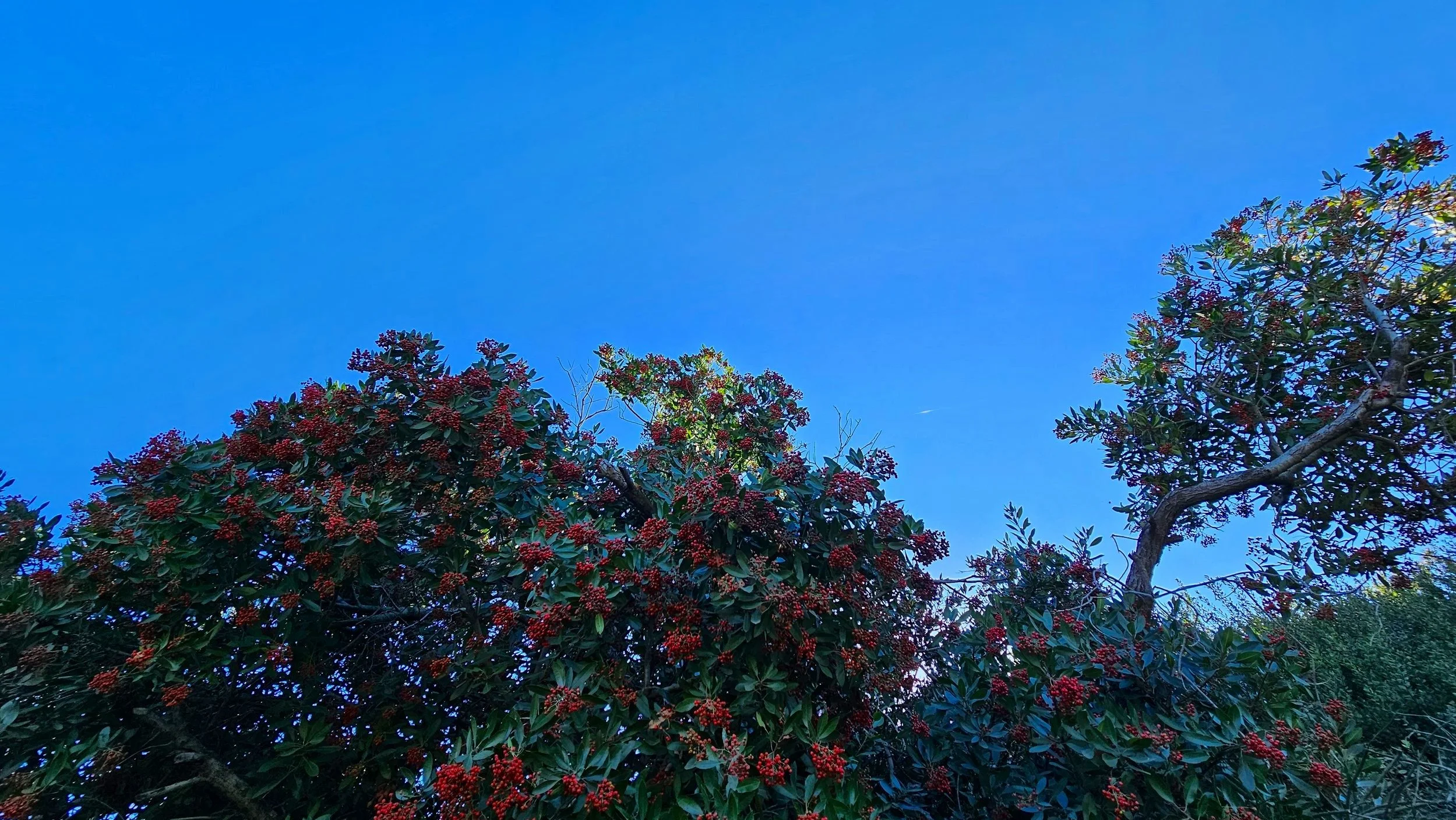
Toyon
Heteromeles arbutifolia | Rosaceae
One of the most dominant shrub species of chaparral ecosystems in Southern California, Toyon provides critical habitat and food sources, especially for migratory and resident bird species.
Description
Habit. 6-30 ft tall shrub or small tree, with rounded or irregular form due to low-lying but spreading limbs; unarmed.
Leaves. Petioled and alternate simple leaves, evergreen; blade 5 - 10 cm, generally elliptic, leathery, finely toothed leaf margins. Classic example of a sclerophyllous leaf.
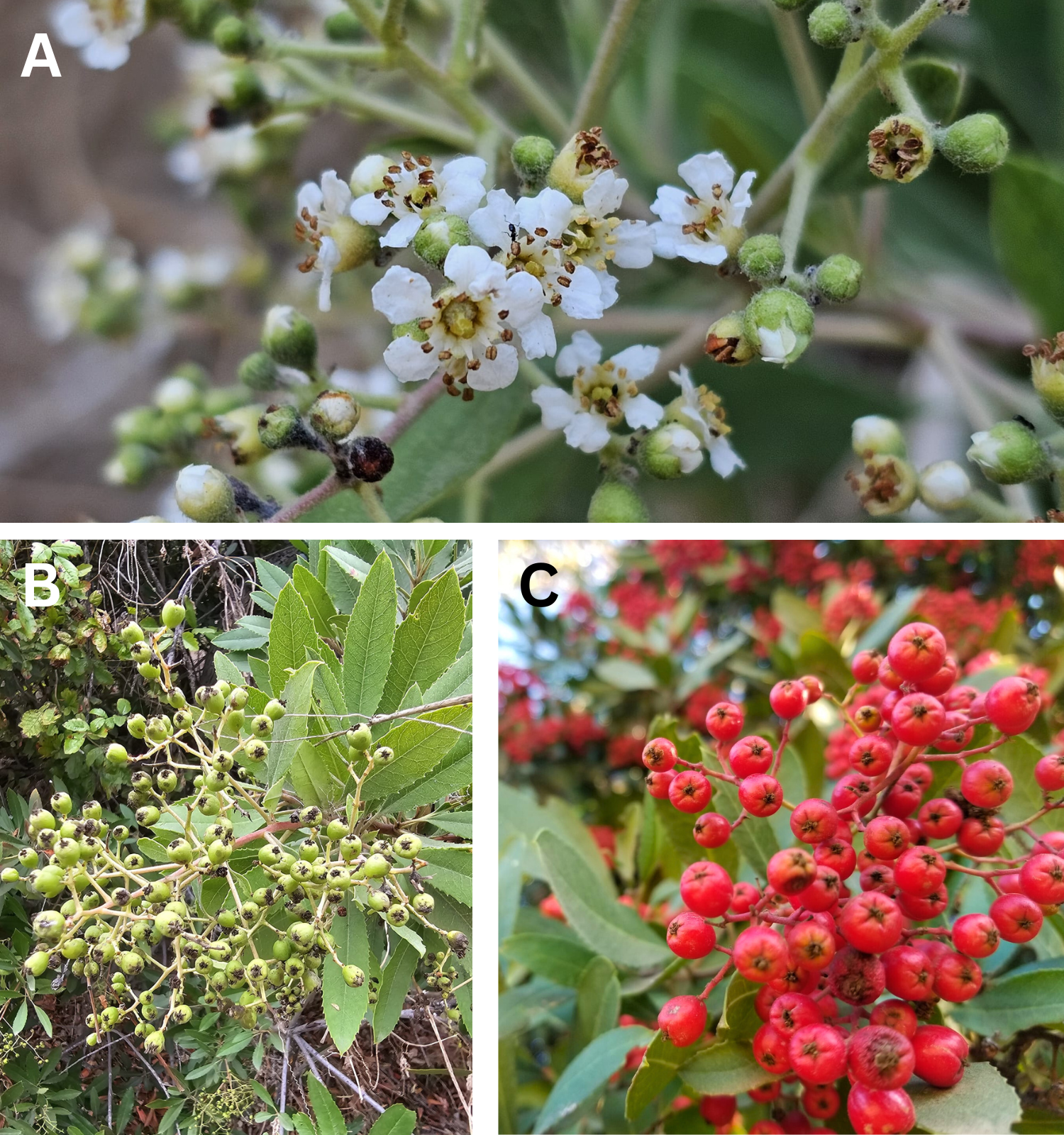
Flowers. Like most members of the Rose family, flowers are hypanthiums. urn-shaped. Flowers have five round-shaped white petals. Flowers occur on a domed panicle.
Fruit. A pome, each 5 - 10 mm in diameter. Elliptic. usually bright red, but orange and yellow cultivars also exist. pulp mealy. Each pome contains 2 - 3 large and brown seeds.
Phenology. Evergreen with leaf flush in early spring, flowering in late summer, and fruit maturation in late fall to early winter. Vegetative growth slows down during flowering and fruiting.
Ethnobotany
Toyon was widely used by California’s Indigenous nations as a source of food and strong wood. The Chumash, Gabrielino-Tongva, and Ohlone processed the fresh red berries of Toyon by either toasting the berries on a soapstone olla or drying them out under a hot sun. Dried berries were then allowed to further ripen over the coarse of 3-10 days until they were soft and sweet. Some Indigenous nations consume the Toyon berries fresh, although many historical and current anecdotes describe that fresh berries are mealy and hard to swallow despite their fresh apple taste.
Toyon, like many other members of the Rose family, are thought to cause cyanide poisoning in many herbivores that forage on the plant. Despite this, a recent phytochemistry analysis shows that Toyon leaves contain no cyanogenic compounds (Wang et al., 2016). This study also found that Toyon leaves contain many anti-inflammatory compounds that may help prevent damage to the blood-brain barrier—a process that has been implicated in the development of Alzheimer’s Disease.Toyon produces a strong hardwood that is resistant to decay — even when partially buried under earth. Indigenous nations utilized this wood to create strong tools, utensils, cookware, and weapons.